
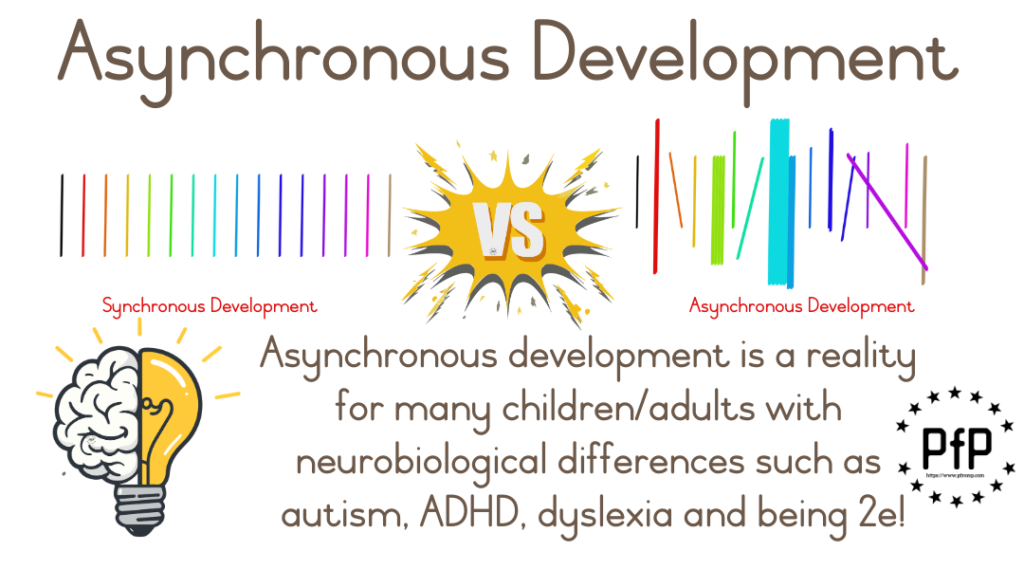
This blog post is written for parents of asynchronous children. It explores how to support gifted or twice-exceptional (2e) children at home or through homeschooling by meeting their diverse learning, emotional, and developmental needs. It invites parents to see the whole child while acknowledging the reality that growth is often uneven. A child may soar in one area while struggling deeply in another. Having strengths in one area does not eliminate struggles in another. Living in the asynchrony space can be confusing, exhausting, and difficult. This post acknowledges that reality with compassion, offering understanding and support for the journey parents and children are walking together.
This is a LIVING article, updated constantly!
This blog post also want to remind parents and the children/teens who may be reading here, that asynchronous development does not mean that YHWH did not create us perfect – He created each one of us with intention. Each one of us are perfect and deeply loved by YHWH. Being different does not equal imperfect or incapable. It simply means that a different path of growth is unfolding. Yes, we live in an imperfect world. Sin (mine, yours and that of others) has affected many aspects of life on earth, and that includes the ways our bodies and minds develop. We feel the impact of that brokenness. We are not without hope – we can still do all things through Christ who strengthens us. He desires to lead and guide us through every part of this journey; if we allow Him to!
As we are reminded in Philippians 4:13
I can do all things through Christ who strengthens me.
And in Psalm 23:2
He makes me to lie down in green pastures; He leads me beside the still waters.
Also, Psalm 4:3 reassures us:
But know that the Lord has set apart for Himself him who is godly; The Lord will hear when I call to Him.
And as we are taught in John 17, we are in this world but not of it.
Still, while we journey here, we are affected by the realities of this world. We face challenges. We experience tribulations. Yet through it all,
YHWH remains faithful and present with us every step of the way.
You said something about asynchronous development, well, let me ask you this:
Is your seven-year-old reading complex Grades 9-12 (age 12+years), yet still struggling to tie their shoelaces? Is your five-year-old solving complex maths problems, but unable to remember simple daily routines? Or perhaps, like my own son at two years old, your child could assemble a brand-new fan perfectly while the adults were still reading the instructions, yet experienced significant speech delays for many years. Does it sometimes feel as though your child simply doesn’t “fit” into any single grade or stage, as if different parts of them belong in entirely different places developmentally?
If these examples feel familiar, you’re not imagining things and you’re not alone! Your child is not failing, and neither are you. Many parents notice this unevenness long before they have words for it. It can feel confusing, even unsettling, to watch a child shine so brightly in one area while needing so much support in another. This pattern has a name: asynchronous development, often described as having a spiky profile.

Asynchronous development and spiky profiles are closely related and often used interchangeably, though they describe slightly different aspects of the same phenomenon. Asynchronous development refers to the uneven pace at which a child matures across different domains:- intellectual, emotional, physical or social. A spiky profile is the way this unevenness often shows up on cognitive and physical assessments or in day-to-day life, with profound strengths and challenges.
For the sake of simplicity, this article uses both terms to describe the same concept to point out differences in the development path that is neither simply “ahead” nor “behind.” Instead, it is uneven, complex, and deeply individual. Most importantly, this perspective reassures us that these children do not need to be “fixed” to fit expectations. They need understanding, flexibility, and support that nurture their strengths while gently scaffolding their challenges rather than expecting them to conform to typical age or grade level expectations.
These concepts are layered and it’s not just theory; it’s lived experience of a parent (me) to parents (you) living through it now. Understanding asynchronous development isn’t just about grasping the concepts, but it is about allowing ourselves to gently let go of old expectations and allow a new lens to shine a compasionate light. With YHWH’s guidance of course, as no one child is ever the same – typical or asynchronous development. Coming from a place of understanding help the parent to flip the script from judgemental/demanding to one that is patient and supportive.
Let us explore asynchronous development (spiky profile) more deeply together, so that a deeper understanding can help us shift the script from frustration or confusion to clarity about what is truly happening. With understanding we can intentionally respond in ways that are supportive, compassionate, and genuinely helpful to our children.
Asynchronous development in gifted or twice-exceptional (2e) children can present in many different ways. As we grow in our understanding of what it truly means, we become better able to recognize it in our own neurobiologically different children.
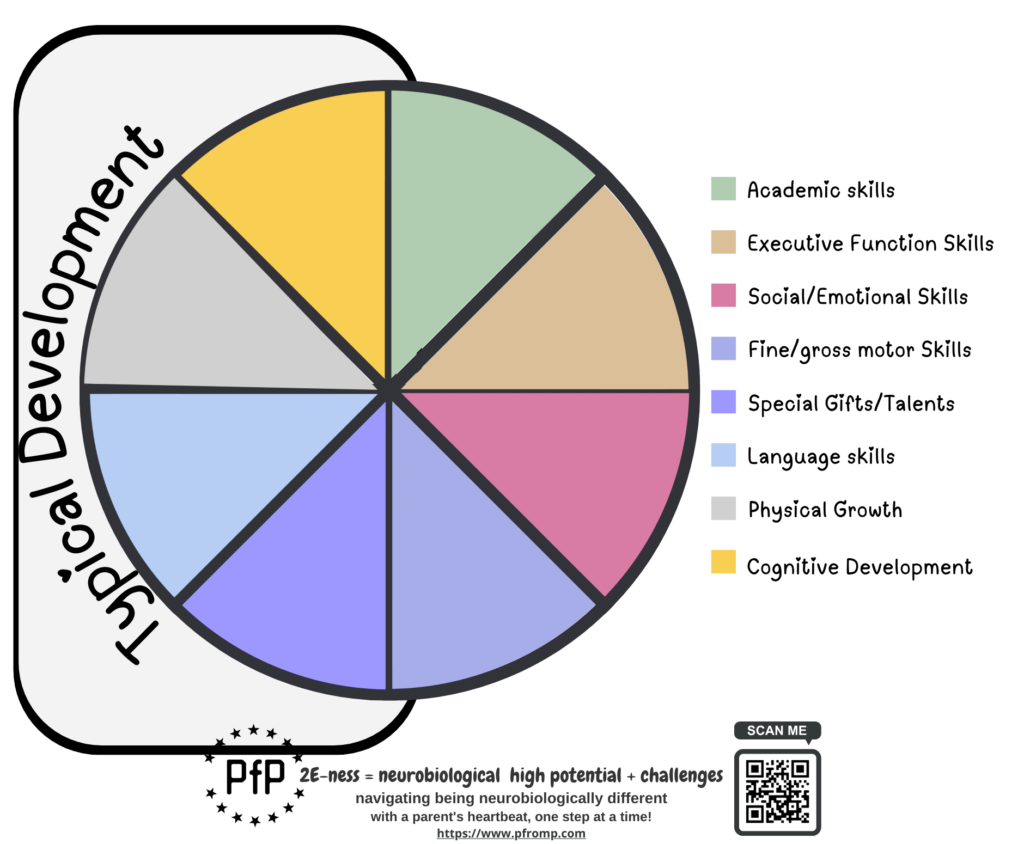
In typical development, all the areas (domains) of growth happen evenly. Mainstream children appear to be even in all developmental stages.
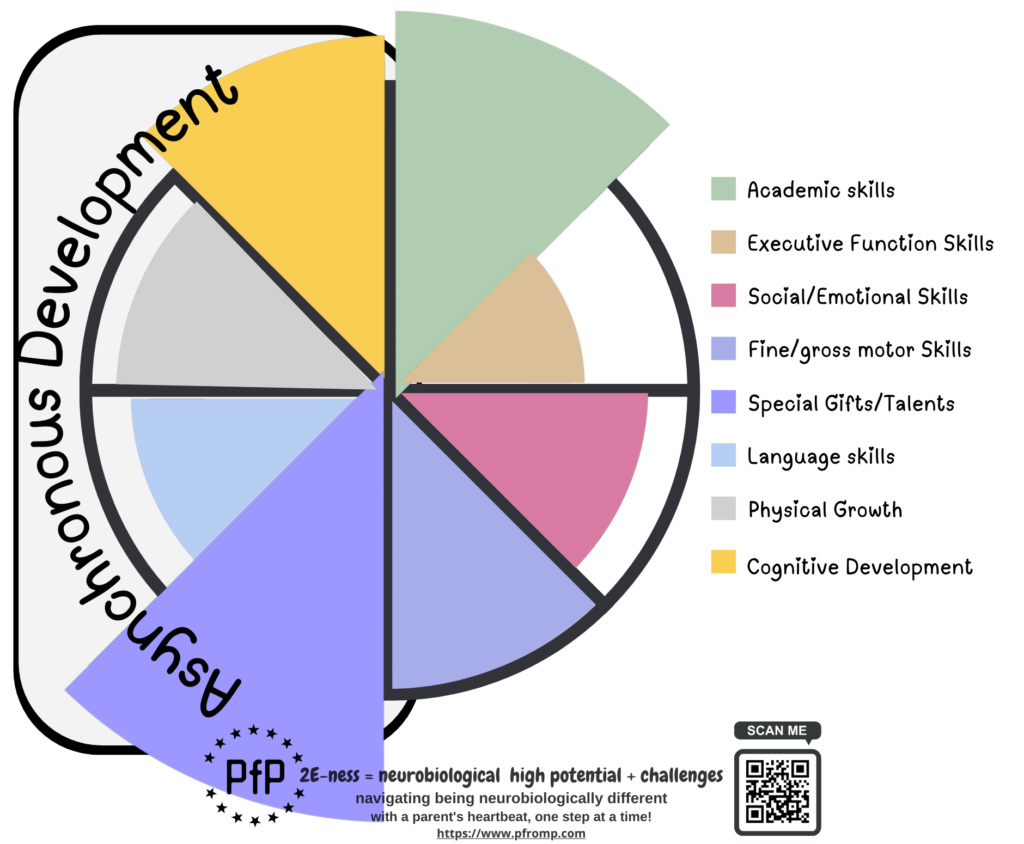
The spiky profile will look different from child to child, as different developmental domains can spike or lack from child to child.
What exactly is asynchronous development?
Asynchronous development means that different areas of a child’s development grow at different rates.
A child may be far ahead in one area and lagging in another — sometimes by many years.


In one of her podcast episodes, Colleen Kessler gives an excellent example:
“They have deep existential thoughts about the universe but they’re throwing a tantrum over the wrong color plate,”
The tantrum over the plate is not hypocrisy, manipulation nor defiance.
It’s a nervous system that simply cannot yet manage disappointment even though the mind is brilliant and so advanged.
This is exactly why parents of asynchronous children often feel lost, because they are parenting multiple developmental ages/stages in one small human.
Here are more examples of asynchronous development:
* Advanced thinking + younger emotional regulation and poor stress tolerance.
* Advanced thinking/abilities + speech delay and slow processing
* Sophisticated language + weak executive functioning
* Deep empathy + poor stress tolerance and resiliency,
* Strong reasoning + delayed social skills and emotionally younger.
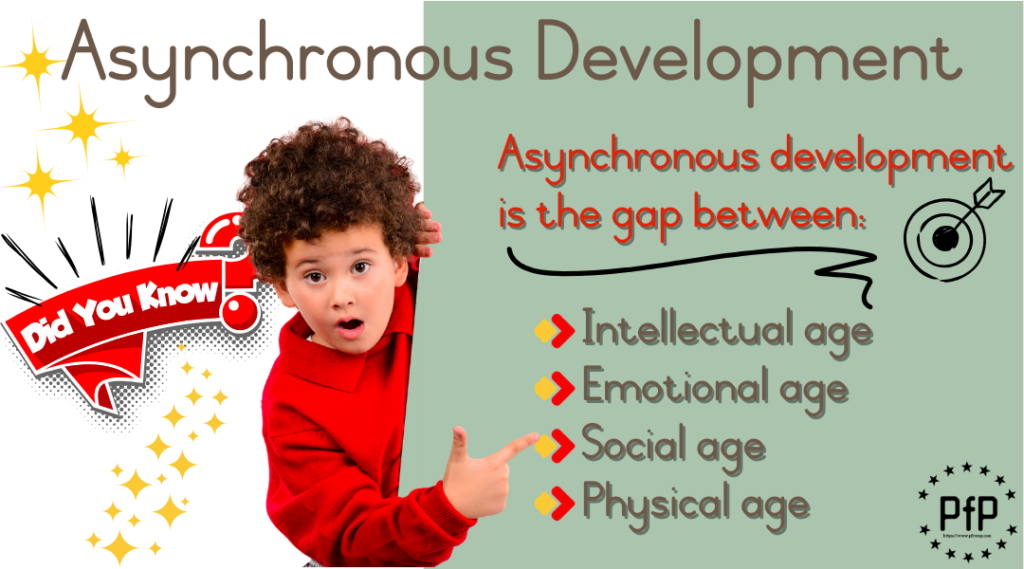
also between:
Special gifts/talents
Cognitive Development
Academic skills
Language skills
Executive Functioning skills
Social/Emotional skills
Fine/gross motor skills
Physical Growth
Asynchronousy is especially common in:
* Neurobiological different children (Autism/ADHD/Dyslexia/ect)
* Gifted and twice-exceptional (2e) children
But it can occur in any child.
Susan Baum, PhD – Professor Emeritus and Director of the 2e Center at Bridges Academy, throughout her lifework emphasized that development does not move in a straight line and expecting it to do so can create unnecessary suffering.
Why asynchrony is so hard?
Children with asynchronous development live with constant mismatch between:
* What they understand
* What they can do (produce)
* What others expect of them
This mismatch often leads to:
* Chronic frustration
* Shame (“Why is this so easy for everyone else?”)
* Anxiety or shutdown
* Explosive behavior or withdrawal
Parents, meanwhile, are often caught in an impossible bind:
* One moment their child seems capable and insightful
* The next moment they seem unable to cope
This can lead to confusion, exhaustion, and self-doubt:
“Am I expecting too much or too little?” or “what am I doing wrong?” is the type of question that burden parents
A crucial reframe for families to adapt is that: behavior Is communication, not character/parenting issues.
Across disciplines:- psychology, neuroscience, education, and therapy – there is growing agreement on one core truth:
Kids do well when they can.
This principle, central to the work of Dr Ross Greene, invites us to stop asking:
“What’s wrong with this child?”
and start asking:
“What is up? Why now? What skills are missing and what support is needed?”
Also ask – is it won’t or can not yet?
When a child struggles, it is often not because they won’t, it is because their nervous system, skills, or capacity are overwhelmed or not yet able too.
This is also a Biblical principle, though not worded like this per say – but the idea of struggle is not being willful rebellion, but often limitation and that God responds with understanding. He is a God of love and grace – we should be parents of love and grace too!
Isaiah 42:3
A bruised reed He will not break,
And smoking flax He will not quench;
He will bring forth justice for truth.
This verse reflects the kind of heart we are invited to have – not crushing what is fragile, but strengthening it patiently.
Also see Psalm 103:13-14
As a father pities his children,
So the Lord pities those who fear Him.
For He knows our frame;
He remembers that we are dust.
This verse illustrates the idea that God understands our capacity and limitations. He does not expect from us what we are not yet able to give. In the same way, children often do well when they can and when they cannot yet, there is a reason. As parents, we too must understand with compassion and help our child to figureout what is missing that will enable the “not yet part!” What is more than this, is that it matters not if we know not how to figure it out as we can ask YHWH to help us:
James 1:5
If any of you lacks wisdom, let him ask of God,
who gives to all liberally and without reproach,
and it will be given to him.
The nervous system matters!
Many challenges associated with asynchronous development are not primarily cognitive or behavioral – they are physiological.
Research and clinical work by clinicians who are thought leaders such as Stephen Porges, Mona Delahooke, and Stuart Shanker show us that:
* A stressed nervous system cannot access higher-level skills
* Emotional regulation must come before reasoning
* Safety and connection are prerequisites for learning – thus CONNECTION OVER CORRECTION.
For many asynchronously developing children, the world feels too loud, too fast, too demanding, even when they appear okay on the surface.
Why parents should let go of traditional expectations:
Children with uneven development are often held to expectations based on their strengths, while their struggles are misunderstood.
For example:
* A verbally advanced child is expected to self-regulate like an older child
* A bright child is expected to manage time, organization, or emotions independently
* A socially insightful child is expected to handle peer dynamics effortlessly
This gap creates chronic stress and stress impairs development.
As clinicians like Dan Siegel remind us, integration happens through harmony or being of the same mind towards, not pressure.
Romans 12:16
Be of the same mind toward one another. Do not set your mind on high things, but associate with the humble. Do not be wise in your own opinion.
Being in harmony / same mind towards is to be deeply present, aware, and responsive to your child’s emotional, physical, or energetic state. It involves reading subtle cues like body language and voice tone to foster a sense of being seen, heard, and understood, which is vital for building secure and healthy relationships. CONNECTION
How parents can support asynchronousdevelopment
1. Adjust expectations without lowering belief
Support does not mean “giving up” or “letting go of growth.”
It means:
* Expecting behavior that matches capacity, not intelligence
* Separating potential from current ability
* Holding a long-term view
Your child is not behind – they are developing differently.
2. Focus on lagging skills, not punishment
When challenges arise, ask:
* What skill is hard right now?
* What support would make this easier?
Executive function coaching such as Seth Perler and collaborative approaches help children build skills without shame.
3. Prioritize connection over compliance
Connection is not permissiveness – it is regulation.
Children borrow calm from the adults around them.
Feeling safe with the parent (adult) enables growth far more effectively than control.
4. Make space for strengths and struggles
Asynchronous children often hear:
“You’re so smart – why is this so hard?”
A more supportive message is:
“Your brain is amazing and it’s still growing in some areas.”
Celebrating strengths while scaffolding challenges builds confidence.
5. Regulate before you educate
When emotions run high:
* Reduce demands
* Increase predictability
* Offer co-regulation
Regulation unlocks attention, motivation, and learning.
In summary:
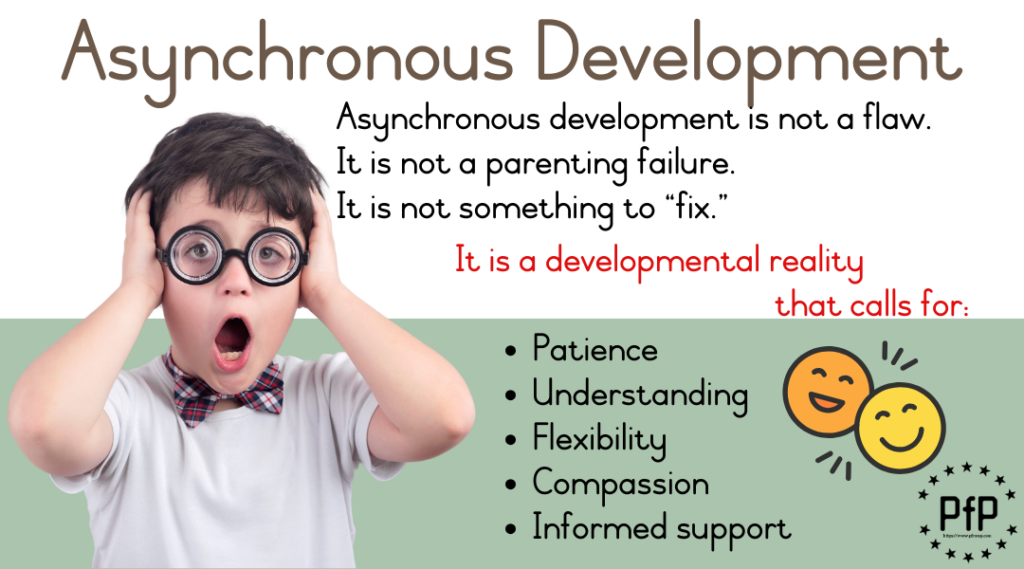
Many adults who struggled as asynchronously developing children, including advocates like Temple Grandin and Jonathan Mooney, said that being understood changed their lives.
Your understanding today becomes your child’s resilience tomorrow.
You don’t need to have all the answers – know that YHWH will guide you!
You only need to stay curious, connected, and willing to meet your child where they are – not where you or others think they should be.
Don’t let asynchronousy steal your or your child’s joy, a little understanding gows a long way and hold many a happy moment for you and your child to discover and embrace.
Remember:

In the comments below, please share what asynchronously means to YOU!
Thank you kindly,
Your fellow Plutonian
♫Ah,Willa!♫
Please come back from time to time as we will add new information and references in due time.
You are also welcome to read/leave comments just below the signature.
Further Reading and/or References
coming soon!
More reading/reference links will be added over time.
Good day
I have a daughter with both autism and adhd .
Hey Fatima
Is your daughter also asynchronous in her development? Did this article help you?